
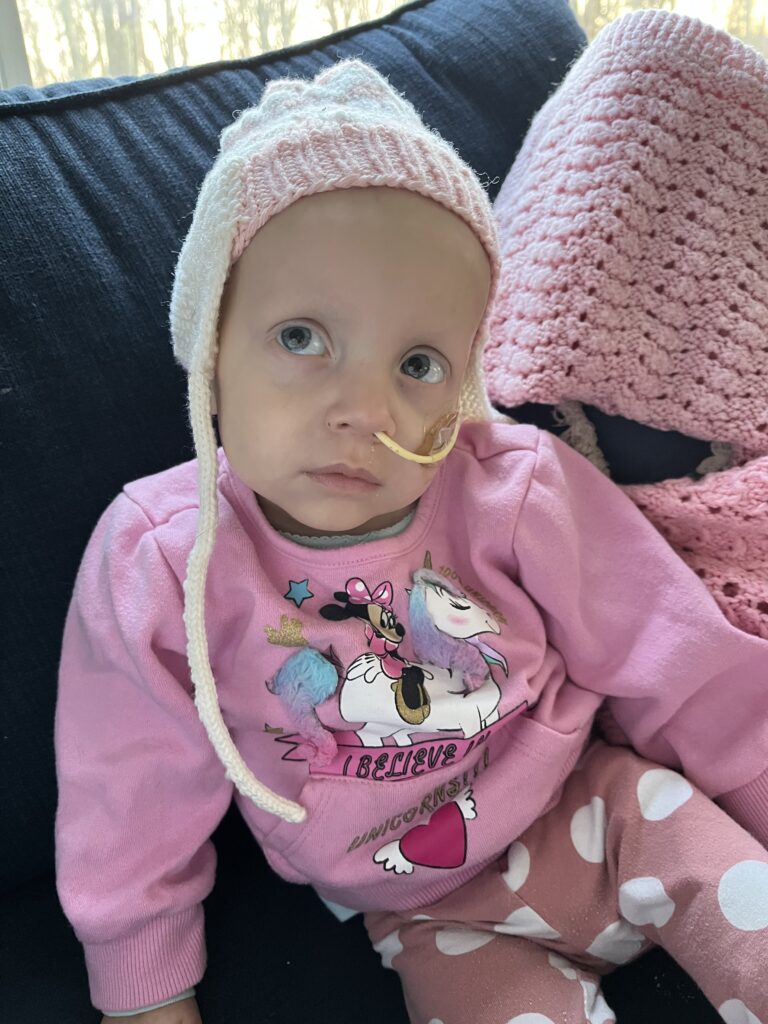
A little over a year ago, I woke up and my daughter June was gone. She died from neuroblastoma when she was one-and-a-half years old after ten months of aggressive treatment. My passion for the roles I’d once fulfilled before June became sick were also gone, like the love of cooking for my family.
Once in my life, I had been a good wife. Once, I had enjoyed cooking. Once, I didn’t mind cleaning. I actually enjoyed vacuuming until June and I vacuumed every day as part of our new immunocompromised routine, killing time before the never ending hours inside the house killed us. Pediatric cancer took from me the things I enjoyed.
During June’s treatment someone once said to me, “Without joy there is no pain and without pain, how can we experience joy?” and I thought, “Oh my God. You’re right.” I’d never experienced pain on this level. The bad moments were excruciating, but the good moments were magnificent. It was a high and a low I’d never felt before June was diagnosed.
June died and my world went gray. There was no joy. There was only pain.
The morning after the evening June died, I woke up and I felt like I was also going to die. I had no desire to live. I imagine this is what it feels like to die from a broken heart. To flatline from grief. I’d never heard of someone dying from grief, but maybe I’d be the first. Although, I figured there had to be more, so I looked it up. Google didn’t mention others, but told me the emotion of grief can be linked to cardiac damage. I believe Google because I can feel grief wrapping itself around my heart. It’s suffocating and painful.
I can feel a reminiscent charge of energy that still illuminates my heart, but as it turns out it’s only the static energy left over from the last couple years of suffering. It’s an energy I’ve tried so hard to eliminate before it kills me, but it sticks to my insides like a plaque.
My heart wants to stop pumping blood because it knows June’s heart no longer can. A couple of paddles to the chest, a futile attempt to bring me back, would do nothing, but shock me into a deeper level of despair, loneliness, and hopelessness.
I spent every day half-alive in this dark place for months and months after June died. Every person around me inadvertently reminded me of how very much alone I was. How no one could ever truly imagine or understand what it was like to lose a child to cancer.
My belly continued to expand with a growing baby despite how lifeless I felt. It reminded me of why I had to claw myself out of this dark hole, eventually. If I couldn’t find a reason to live within myself that would tether me to this earth, I needed to find an anchor outside of my body. My children were the anchors.
“How can I live life when I wake up void of happiness? June is gone, how can I ever be happy again? I’ll never be happy again,” I told my therapist. I had no desire to procure happiness, but deep down I knew I needed it to continue on with my life. It terrified me. I’m going to die a miserable human being. People will remember me and say “It’s such a shame. After her daughter died, she just stopped living and then she died.” It became a constant push-pull I couldn’t escape. It tortured me. I wanted to keep living, but I didn’t know how to live without happiness.
I sat for months in my misery because I had no other choice. I was paralyzed with grief and nine-months pregnant. I gave birth to our son and then returned home, still paralyzed with grief, but now up all night nursing a baby. I had sunken to the bottom of an olympic size swimming pool of grief.
Through the clear blue water I could see the faces crowded around the edge of the pool trying to figure out if I was going to be okay. Did she inhale water? Will she ever be the same? I could hear muffled voices yelling out to me here and there, but I couldn’t make out what they were saying. I lay very still. Blinded by the light from above, trying but not really trying to make out the blurry figures. Unable to move.
Several months after June died, I woke up and a microscopic piece of me yearned to be happy. I could feel it. A feeling other than grief. It felt strange, but I was interested in feeling it more. It also felt like a betrayal to June and disguised itself as guilt for me, so immediately, I pushed it away.
I realized I had a choice: I could succumb to the anguish, but I’d live a short miserable life. Or, I could see what it felt like to get in touch with that distant desire to be happy. The number of years I lived became of importance again. Not all at once, and not indefinitely, but here and there. Day by day, I didn’t give up.
I dedicated myself to watering and feeding that seed of desire to grow with the death of June and not away from it. I became hopeful again. I realized happiness is not betraying June, unhappiness is. I made a vow not to throw away what good there was left in my life.
Very recently I had my first taste of happiness I know I can take with me everywhere. It is a happiness no one can take away from me. It’s both big and small at times, but it has stayed and never left. I’ve created it by sitting in my misery and rediscovering who I am and what I love, and what matters most to me.
Part of my happiness involves my relationships to all of the things in my life that give me my identity. Something I lost when June became sick. I’ve started over. I’m in charge now. I’m carefully crafting my new identity based on how I choose to live my life, today. I am choosing to be happy. To my marriage, I am a wife. To my peers, I am a friend. To our house, a homemaker. To my children, I am eternally their mother. Nothing will ever change that.
I learned that by embracing all of these roles and doing them with love, I can be myself, and that usually the relationship is reciprocal. I learned that despite losing June, I still have life and in that life there will be happy moments. I can still love and be loved.
I know I will always feel eternal pain surrounding the loss of June. I also know that I will feel immense joy, unlike any joy I had ever felt before June became sick. June’s disease and ultimate death left me with appreciation for life that perhaps I’d never have known otherwise.
The exciting part of this for me is that immense joy comes in small and unexpecting packages like when I peck twenty kisses on my son’s perfect little round cheeks, or when I smell my daughter’s sour, earthy hair before a bath.
Maybe I wouldn’t have acknowledged these as gifts before. Maybe they would have passed me by. The childlike lens I see life through again might be temporary, but then again, it might not be.
I’ve also discovered new joys that never struck me as anything but a chore. Despite cooking no longer being something I enjoy, I do love placing the meals in front of my husband and the kids and hearing the echo of everyone’s special requests: more water please, can I have lemonade?, we need another fork, a napkin, more noodles please!
When we started our family, I set the expectation that I, as the woman, wouldn’t be left in the kitchen to eat a cold dinner. I became resentful when everyone had finished their dinners before I sat down. Today, I sit down to eat dinner well after my family has finished and for some reason, this makes me happy. It fondly reminds me of my Nana who never ate with us. June’s death has helped me let go of resentment and live in the present moment. June’s death has helped me to see the beauty behind eating last.
Now I let it be messy, and disorganized. I know the second I sit down to eat an almost cold dinner that my son will crawl over to me and pull at my pants and throw his arms in the air because he wants me to pick him up. I push my uneaten meal aside and place him on my lap. It’s not that food isn’t important, it’s just that the food isn’t the most important. It’s simply the conduit to everything magnificent I am about to experience.