
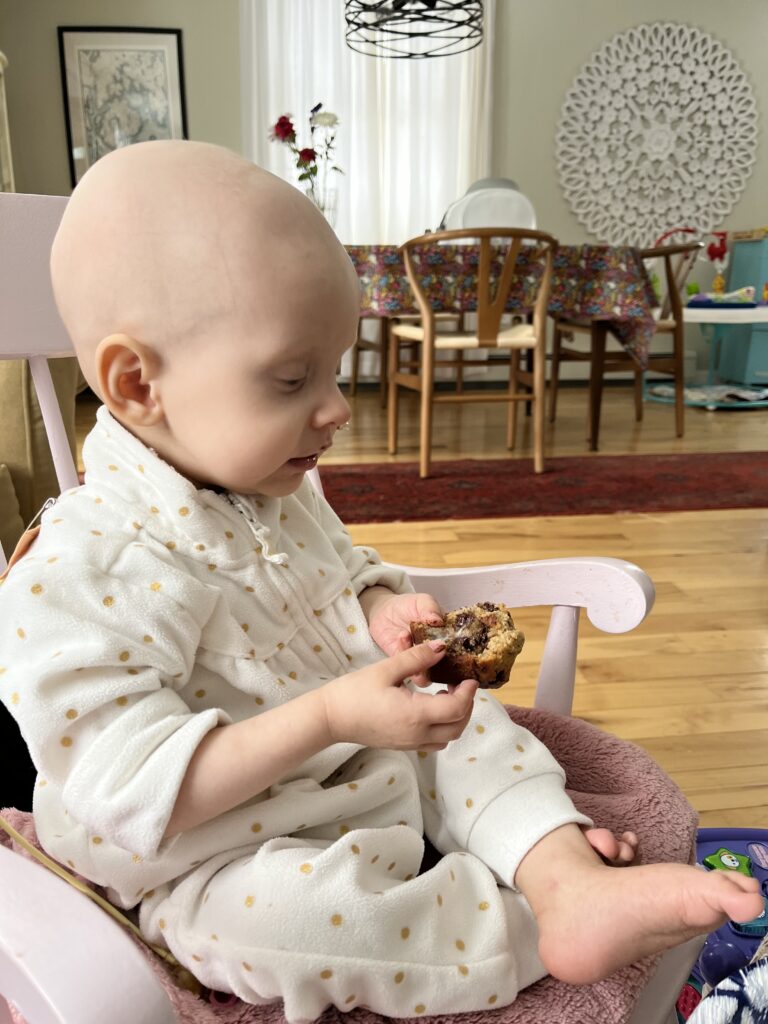
I know the route from Boston Children’s Hospital to the Le Méridien hotel in Cambridge by heart. It’s as if a birds-eye view map has been carved into my hippocampus. We frequented it several times during our daughter June’s treatment for neuroblastoma, and I remember the drive because an acute onset of loneliness would suffocate me as I climbed into my car and shut the door. I’d drive away from June overcome with anguish. I had one million worries and no where to put them.
I’ve stayed at the hotel on two separate occasions. Initially, on-and-off during June’s tumor resection surgery which was a two week hospitalization, and then again during June’s pre-transplant workup, when she and I stayed at the hotel together for two nights.
If you’d asked me before June got sick, I could never have told you how to get to Cambridge from Boston. I had forgotten that the Charles River separated the two cities. As a child, my father lived in Cambridge and would quiz me and my sister every time we passed water, “Name that river!” and without hesitation I’d try to beat my sister to the punch and yell, “The Charles!”
I remember thinking it looked brown. I remember disliking it. I also disliked the city. The loud noises, the heat, the people. I felt like a single grain in a fifty-pound bag of rice. The city and the Charles River felt as if it could swallow me whole. Every time I’d visit my dad, the Charles River was the first reminder that I was no longer home.
Whenever I arrive at the hotel my mind takes inventory of the obstacles separating me from the hospital and June. MIT, the Charles River, various restaurants and bars, Massachusetts College of Art and Design and several tunnels, in that order.
At any given time, the main lobby of the hotel is crawling with people in suits. In the morning, business people drink coffee in white paper cups and mingle. The thought of traveling for work and having new, unfamiliar, encounters seems like an utterly alien existence to me now that June has cancer.
In front of the main elevators and connected to the hotel lobby is a large restaurant which has no doors or walls. One tiny divider between the elevators and restaurant separate you from the bar. The bar turns an electric blue at night, and in the evening, business people sit at the bar in blue tinted suits and drink martinis. They look important and sexy. As I sneak past them to hide behind the divider and wait for the elevator, I see my reflection in them: small, frumpy, exhausted. I feel like a stray dog waiting to be kicked off the curb.
I walk to my room with my eyes cast downward because they are heavy. Because sadness weighs a ton. “You look like you’re going to cry,” my husband will often say to me. “I am,” I respond every time as I bury my face in my hands. The sadness in my eyes never lies.
When I bring June to the hotel the night before pre-transplant workup we check in at the main desk and I tell the man we are the family being treated at Children’s. They offer us a big discount to stay at this beautiful hotel. He looks at June and smiles at us both. “Please enjoy your stay,” he says as he hands me the room key.
I attempt to push her in her stroller, feed bag pumping, tube running into her nose attached to the bag, as quickly as possible past the restaurant, to behind the divider, and to the elevators. I have bags crammed under the stroller and a big suitcase I’m dragging behind me. I’m four months pregnant and besides the growing fetus, I am devoid of life.
June’s just finished a fifth round of chemo. She’s spontaneously throwing up. We made several stops on the way down to Boston to sop up throw-up out of her carseat. I envy the people in suits. We are the anomaly here. I cover June in her stroller with a blanket to protect her from things like Covid and the wandering eyes of happy, busy, business people. I pray she doesn’t throw up in the lobby. I long for my old life where I once casually sat a bar drinking a martini.
My body aches to go home, but we are here for two daunting days filled with back-to-back appointments for pre-transplant workup. By the end of it, we will have seen fifteen different specialists. Each specialist will deliver news about June’s organ function. After five rounds of chemotherapy, do her kidneys still work? Is her heart still sufficiently pumping blood? How much hearing loss have her tiny developing ears suffered?
June and I navigate our way to fifteen different lobbies spread out on the sprawling Children’s campus. In each lobby we are surrounded by kids and their parents. I wonder if any of them also have cancer. I fight back tears and hold my breath each time the nurse enters the waiting room and calls a name.
Soon, a doctor will read me the irreversible list of damage the chemo has caused. Soon, the feeling of June and our family never being the same will be confirmed in these new diagnoses. Soon cancer won’t be the only chronic ailment on June’s list. I don’t want to know. I am afraid of knowing. I cry when the news is bad. I sob when the news is good. “Great news, June’s eye sight is perfect,” the optometrist says.
The first time I leave June and my husband at the hospital to drive to Le Méridien I am alone. We are at Children’s because June has just endured a fourteen hour tumor resection surgery. We will stay at Children’s until she is well enough to go home. I don’t want to leave her, but there isn’t room for both my husband and I to stay in the hospital room. I am nine weeks pregnant with our son.
My husband suggests we alternate nights at the hotel so at least one of us is getting rest, every other night. Before the sun starts to set, despite it not being the end of our day, my husband and I take turns gifting one another an end to the day. On my days, I reluctantly leave the hospital room after rehearsing the notion that it’s probably best for me, for June, and for the growing baby in my belly.
Care for June doesn’t end when the sun sets, therefore sleep when possible is important. When most people are placing their babies and children in their cribs or beds at night, and retreating to their own bedroom to relax, we are often just beginning our night.
There are medications and fluids to be administered. Vitals have to be taken every four hours. The nights echo beeping pumps and alarming monitors. June’s heart rate drops and the monitor screams. June’s oxygen dips and the monitor screams. I jump out of bed. Concerned. Delirious. Barefoot on the hospital floor. Trying to see June in the light of the beeping machines.
The nurse hurries through the door, assesses June, and turns off the alarm. Relieved she is okay, I hush her back to sleep, rub her bald head, and kiss her cheeks over and over again, saying, “It’s alright, close your eyes and go back to sleep baby. Mama’s right here. I love you.”
Every goodnight is like our last goodbye. She closes her little eyes and rolls to her side. She pulls her pink blanket up over her head which is my cue to return to my bed. A half hour later, the same thing happens. All night long, the machines scream, and I run to June, heart pounding, half-asleep.
Every other day for several weeks, while we stay for June’s recovery, I drive to the hotel in the evenings. The first stretch of the drive takes me past a beautiful strip of restaurants with outdoor patio seating. Big lit up signs hover above beautiful people standing on sidewalks in skimpy summer attire, smoking cigarettes or vape pens, mingling with friends.
I always think, “Maybe when June is better, we can come back, just the two of us and enjoy a carefree weekend here.” Me and my husband. Although, living carefree is now a distant, unattainable way of life. I imagine I’ll never feel carefree again as long as I live. I reach for the box of tissues that live on my passenger seat. I wipe my eyes until they are raw. I arrive at the hotel, park, and sit in my car, taking deep breaths, crying the last of my tears, then make my way to the hotel lobby.
In the hotel I walk past beautiful people, feeling haggard and broken. I don’t want to show them that I am a thirty-six year old woman, and I don’t know who I am anymore. Their suits, again, remind me they know who they are. I quickly enter the elevator and press the button. I stare at myself in the unforgiving elevator mirror and curse God, and then beg him to take me directly to my floor without any other stops. I can’t bear to see one more person.
I finally reach my floor and dart in the direction of my room. I find my door and fumble for the key. I swipe the key. I enter the room and collapse on the inside of the door as I bolt the top lock. I turn and look at the room. It’s empty. My bag is on the floor where I had left it the night before last. Clothes are strewn out of it.
The curtains are open, which I immediately go to close, but before I do I stop and stare at the people on the street. I imagine that their children don’t have cancer. I look out to the other rooms across the way. I wonder if they too have locked themselves in.
I walk into the bathroom and flip the light switch on. I take off my dirty, bile stained hospital clothing and drop it on the tiled floor. I turn on the shower and catch a glimpse of myself in the oversized mirror. I examine my growing belly. It feels much bigger when I am wearing pants, but it doesn’t appear that much bigger now that I am looking at it.
I stare into my bloodshot eyes and wonder, how will I get through this? How will I survive? How will I keep a baby alive inside of me while trying to keep my baby alive inside the hospital? I decide I don’t need all of the answers right now. Just a hot shower and a bed.
I allow the hot water to burn the skin on my back. I scrub my body like I’m scrubbing stuck burnt spaghetti out of a pan with a Brillo pad. I can wash off the hospital, but I can’t wash away the pain and anguish. I try anyway.
I rub a little bottle of hotel lotion on my flaming red body so I don’t crack, and put on clean pajamas. I slip into bed and it’s only six o’clock, but my body tells me it’s done. I see a mini fridge next to the tv, and suddenly, I’m hungry.
I get up and open the fridge and there’s one half-full flat mini can of ginger ale my husband brought back from the hospital the previous night. I kick the fridge closed and feel cold water splatter my feet. Yuck, I think. I don’t have the energy to figure out where the water is coming from. There’s no puddle on the floor, so I forget it. I lay back down and close my eyes.
I toss and turn all night long because my body and my mind cannot be at peace. They won’t settle. June is in the hospital. June has cancer. June has had a major surgery that she may never recover from. My brain and body won’t let me sleep because they are trying to solve all of life’s problems.
They are trying to figure out how we are going to overcome June’s cancer and treatment and survive. I tell my body it can’t figure it out tonight and to go to sleep, but my mind won’t listen. All night long, I am running to beeping alarms in blackness.
All night long, I try to find my way back to June without being swallowed by the Charles River.