
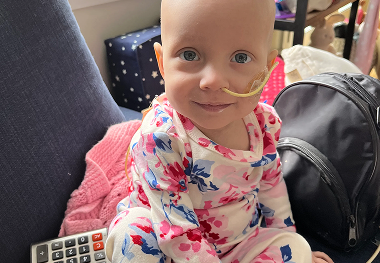
After June was diagnosed with neuroblastoma, I spent my days in the brain, the car, the home and periodically on the treadmill and in a glass of red wine. The home was my most burdensome place. It had once represented our family, a beautiful chaos, bursting at the seams with love and adoration for the little humans my husband and I had created together.
When June became sick the house stopped feeling like home and began feeling like a prison. We lived in Maine and it was the dead of winter and June was immunocompromised. To protect her, we went nowhere, except briefly outside for when the sun peaked in the sky. Many days, the sun didn’t shine. The four powdery walls of every room, once recognizable, now symbolized the opposite of what we had cultivated here, the opposite of love. The house facilitated an us versus them mentality: the outsiders versus us, the insiders. The outsiders were the lucky people enjoying life in the outside world oblivious that June and other kids were dying of cancer.
The more days we spent confined to the house watching the cars drive by on their way to work, the store, or the beach, the more we were reminded of what our lives had become, and the angrier I became. “What do people have to do that’s so important, anyway?” I’d think to myself as I looked out the window for the hundredth time that day watching the seemingly carefree cars pass by full of families laughing and singing, with their healthy kids buckled blissfully inside. I’d look down at my sweet June perched on my hip with her bald head and sunken eyes. The divide had become a canyon. Us, the sick ones imprisoned here inside, and them, the healthy ones free to roam wherever they chose. We became lost in a new, ugly, and painful chaos. I longed for normalcy. I prayed for June to get better. Our old life had become a distant memory.
I kept June safe by not leaving the house. At the start of June’s treatment, it was summer, the month of June. Her immune system started taking a hit, so we reduced our family’s exposure to indoor environments which was relatively easy. Instead of eating inside the restaurant, we opted for the picnic table outside. Simple and not overthought. Instead of meeting a friend at their house to play, we met at the beach. We allowed no one in our house except a few family members, and on occasion, completely vetted and healthy friends. I didn’t do temperature checks at the door, but handwashing was mandatory. Then something shifted. As we gained momentum with chemotherapy, suddenly, I became obsessive over summer colds. Covid, a constant, nagging worry, became an uncontrollable animal that kept me up at night. Everywhere I looked, there was illness. Surfaces harbored diseases. Everything was contaminated.
I stopped going to the grocery store, and with no other choice, finally took the advice of a former coworker to try grocery delivery. The groceries started showing up at my door. The little indiscriminate car would pull into the driveway and June and I would peek out the kitchen window as we always did together. “Groceries are here, Junie!” and then we’d go sit on the living room floor on the playmat, and hear, thud, one, thud, two, thud, three, thud, four, thud, five, thud, six, then silence, and I knew it was safe. I knew the person who had left the groceries had gone and wasn’t going to get June sick. “I think that’s all of them.” I’d tell her so to prepare her that I would be stepping away from her for several minutes. So she wouldn’t panic. June did not like when we were not physically bonded. Neither did I. I’d walk away listening to her protest in the form of whines and shrieks filled with sadness and anger, trying to quell my own panic, as I opened the front door. I could see the car backing out of the driveway. I’d throw my hand in the air while I bent down and picked up one paper bag. I’d hold my hand in the air for a couple seconds until I heard them drive away, to express a thank you, a token of gratitude, for someone who did something so personal for me. A person who delivered the nourishment my family needed to survive the inside world. I’d carry the groceries inside, then wash my hands. I’d spray the paper bags with Lysol, then wash my hands again. I’d let them sit on the kitchen floor until I felt like it was safe to touch them. Then I’d unpack them, and wash my hands. Like this, we lived our lives inside.
Then fall and winter came. The brutal cold accompanied by days of endless gray, ice storms and viruses. The flu, RSV, covid, the random stomach bug, and the common cold were our undying enemies. Our oldest daughter, three-years-old at the time, was still attending daycare several days a week which made being inside the home very dangerous and uncomfortable. There was no longer anywhere we could go and be safe from sickness. Simultaneously, there was an uptick in June’s hospital admissions. We were no longer only there for just the weeks of chemotherapy. We were there for surgeries, dehydration and fluids, neutropenic fevers, and for weeks of antibiotics when the infections started. June’s little body was so frail. We didn’t know if her immune system would be able to fight any additional sickness. As her Mama, I did my best to envelop June. So often, I’d wish she could just get back inside the safety of my womb. I did my best to recreate that environment by forming a protective bubble around her with my body. Before each hospitalization, I laced up my combat boots to fight the invisible enemy. It didn’t take long however for the invisible enemy to become one with the people we constantly encountered. I began to fear every new person who walked into June’s room. I’d watch carefully, did they sanitize before entering the room, could I hear a scratchiness in their voice from behind their mask, did they have sick kids at home? I’d pull June in closer to me.
Our family’s life in isolation was lonely. Our home, no longer the place I longed to return to at the end of the day. Instead, I’d sit and stare at the walls for hours crawling out of my skin. Light filtered in and out, and from a distance, I watched the seasons change. The leaves turned red, brown, orange and fell off the trees. The white snow blanketed the branches after a storm.
When we were in the hospital, it was much the same, just another place I was imprisoned. In order to survive, I had to completely detach myself from the outside world. I had to make sure it meant nothing to me anymore. I pretended it didn’t exist. I completely cut myself off from the things that once had brought me joy, but now made me painfully sad, like hanging out with friends. All that mattered was June. I’d go from the house to the garage to the car to the hospital entrance. I’d take two or three puffs of icy air between the car and the hospital entrance, and then I’d settle back inside for an indefinite amount of time. A week or two, or four. This wasn’t the home or way of life I had imagined giving my children. Ceasing to exist wasn’t exactly how I pictured my life as a mom. I was no longer the role model I always wanted to be for my girls. I didn’t know who I was anymore. Every day I woke up, and so it didn’t hurt quite so much, I worked on continually numbing myself from the inside out.
Sometimes, I envision what June’s home is like now. I know it’s better than this, and I also know I gave her the best home I could. Early in treatment, a nurse said to me, “You are June’s home. No matter where you two are, as long as she is with you, she is always home.” In hindsight, I believe that the nurse’s words were the exact reason I sacrificed my outside life. So I could fully and solely exist as June’s home, and so that June could survive another day to live in it.
When I handed June over after she died, and after I’d held her as long as I could, I felt like I was telling her through the action of giving her to someone else, that I was no longer her home. The absence of her felt like I had partially severed an artery. Physiologically it was something I needed to repair in order to survive, but I had no choice. There was no fine silk or needles to sew the tear. I’d have to figure out a way to live without it being repaired, in order to keep my life. That’s what it feels like living without June.
Today, my body is no longer the same home June and I once shared, but it will always be a home for all of my kids to return to. Our physical house is the same as when June was alive, but it’s no longer a prison. Every day June and I were together and multiple times a day, I told her the only thing I knew to be real in the midst of our upheaval, and it still stands true today, “June, I am your Mama, and you are stuck with me. I will never leave you. I’m always going to be right here.” I trust she knows that and will come home whenever she wants to. Junie, Mama is right here. I will always be your home.
Written by Taryn Jarboe, RN
Founder Carrying June